Journal · Design Judgment
What the false ceiling actually decides
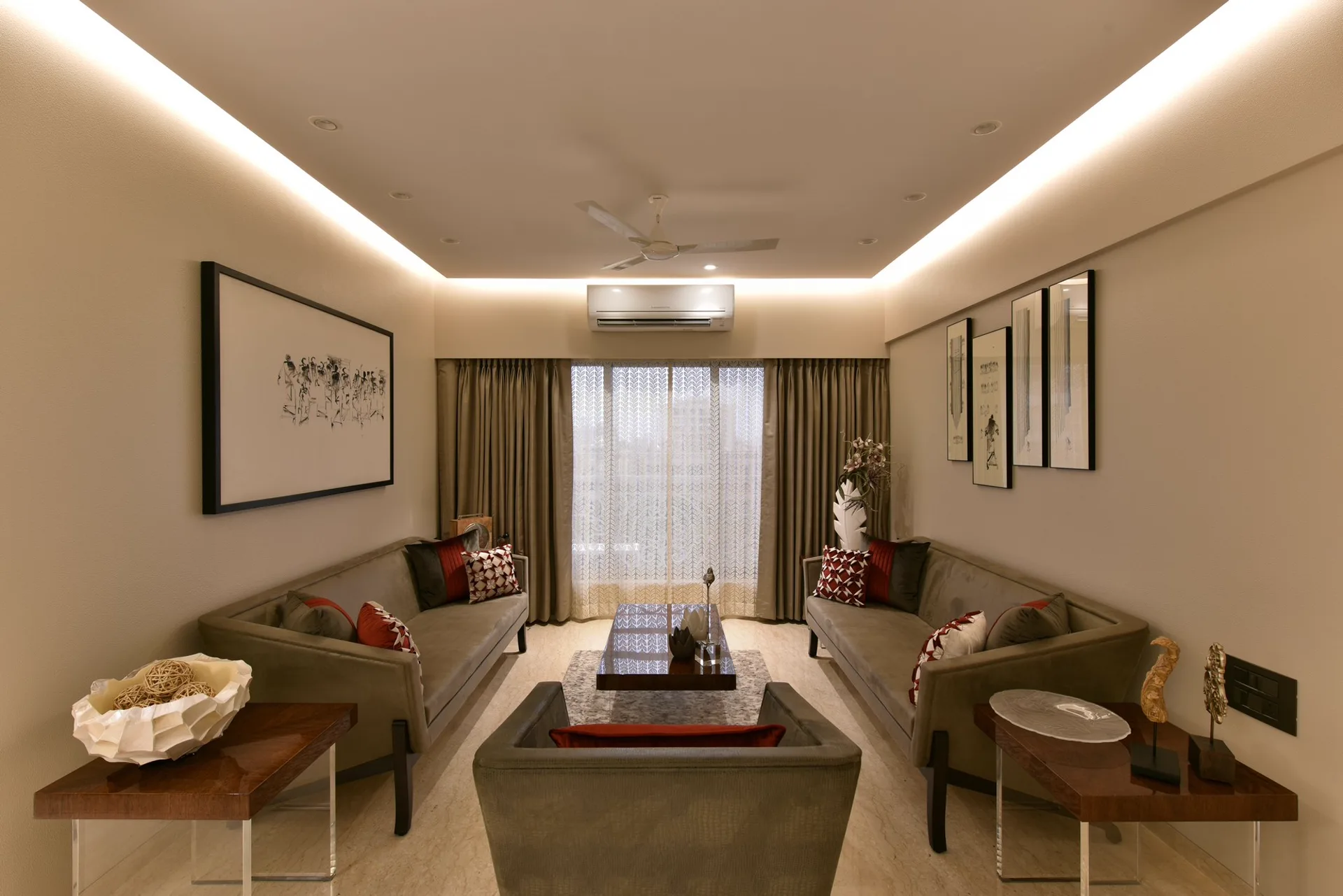
The ceiling closes once. The three decisions that happen before it does — fixture profile, colour temperature, and switching plan — determine how every room in the home feels at night, for the life of the home.
Short answer
False ceiling lighting is not a specification. It is the infrastructure of how a room feels every evening.
Most homeowners spend the most time choosing finishes — marble, wallpaper, joinery veneer. The ceiling decisions tend to happen quickly, often delegated to a contractor with a standard plan. That plan gets installed, the boards go up, and the room is committed.
The lighting embedded in that ceiling will shape how the room feels every evening for the next twenty years. It determines whether guests sit comfortably or find the space too bright or too flat. It determines whether your chandelier reads as a statement or disappears into the general brightness. It determines whether the room transitions from day to night — or stays at one intensity, indefinitely.
Decision 1 · Mumbai specifically
The fixture profile is a height decision, not a light decision.
In Mumbai, finished ceiling-to-floor height after a false ceiling is typically nine to nine and a half feet. Standard recessed housings need 100mm or more of depth behind the finished surface — that depth is subtracted directly from room height. The fixture is only the visible tip; the housing behind it is where the height goes.
European manufacturers — and a few Indian ones now — make recessed fittings with a housing profile of 35 to 40mm. The finished aperture looks almost identical to a standard fitting from below. The difference is two to three inches recovered per room. At nine feet of finished ceiling height, that recovery is visible and felt. At nine and a half, it is the difference between a room that breathes and one that presses slightly downward.
This decision happens at the procurement stage, before the ceiling boards close. After that, the height is gone. Specifying a slim-profile fitting is not an upgrade — it is the correct default for Indian residential ceilings.
Decision 2 · Colour temperature
Daylight bulbs are the most common way to make a good room feel wrong.
The logic for daylight (5000–6500K) seems correct: more apparent brightness, better colour rendering for the eyes. What it actually produces in a living room at seven in the evening is a room that feels like a hospital corridor. Wood looks flat. Stone reads grey instead of warm. Velvet fabric looks like a different material than it did in the showroom. The expensive sofa you chose in afternoon light becomes unfamiliar at night.
2700K to 3000K is where warm materials look the way they were chosen. It is where marble shows its veining correctly, wood grain is readable, and the room transitions from a working space to somewhere you want to stay after dinner. This is also why interior photography shoots often use daylight setups — the camera reads it well, but the room that photographs beautifully and feels cold to live in is almost always a colour temperature problem.
The cove, the recessed points, and any supplementary lighting should all run at the same temperature. Mixing — warm cove, daylight downlights — creates a visual dissonance that reads as inexpensive even in expensive spaces.
Decision 3 · Switching plan
The switching plan is the design decision. The number of fixtures is just the specification.
A room with fifteen recessed lights on one switch has one lighting condition. You can turn it on or off. A room with eight recessed lights across three switching circuits has at least seven usable combinations: full room, perimeter wash, focused cluster near seating, cove only, and pairs of any of the above. The eight-light room is more versatile than the fifteen-light room, because the design decision was made at the circuit level, not just the fixture count.
Contractors and electricians default to one circuit per zone because it is simpler to wire and easier to explain to a client. The result is a ceiling full of lights with no atmospheric range — rooms that look acceptable during the day and feel flat or harsh after sunset.
Modern LED at 7 to 8 watts per fixture is already powerful. Eight recessed points at full intensity in a 400 square foot room is more than enough general light. The question is not whether you have enough — it is whether you can choose which part of the ceiling is lit, at what combination, depending on whether you are hosting a dinner, watching something, or simply sitting at the end of the day.
Three circuits minimum for a living room: full coverage for practical use, a perimeter wash that includes the cove, and a focused group near the primary seating. Those three, used individually or together, give the room a real range without a single dimmer.
The chandelier problem
A chandelier competing with twenty ceiling points will always lose. So will your floor lamp.
The reason statement light fixtures fail to read in so many Indian homes is not the fixture — it is the ceiling beneath which it hangs. When all recessed points are running at full intensity, a chandelier or designer pendant becomes one source among many. It loses visual hierarchy. The room has no anchor because every point on the ceiling has equal weight.
A chandelier works when the ceiling layer steps back. That means recessed lights on a circuit that can be dimmed or turned off in the zone directly above and around the pendant. The fixture then holds the room's visual focus because it is the brightest point in the space. This requires one additional circuit and the discipline to leave those downlights off when the pendant is on.
The same principle applies to floor lamps and table lamps. A well-placed arc lamp by a reading chair adds warmth and purpose — but only if the ceiling layer is not already flooding that corner. Layered lighting functions as a hierarchy: ceiling provides ambient base, pendant or chandelier provides the statement and visual anchor, floor and table lamps provide intimacy and task. These three layers need to be able to operate at different intensities. When the first layer is always on at full brightness, the other two become invisible and the room never earns its own atmosphere.
Trends worth questioning
Three ceiling decisions that look like upgrades and function like problems.
01
RGB and colour-changing LED coves
A cove that shifts from amber to blue seems to offer atmosphere on demand. What it actually does is break the room's colour science every time it is used. Blue or purple cove light makes warm materials look wrong — the stone reads cold, the fabric reads grey, and the room looks like a nightclub lobby. The cove's function is to add soft indirect fill at the correct temperature. Making it a feature is the wrong use of the element.
02
The uniform recessed grid
A grid of evenly spaced recessed lights across the entire ceiling treats the room like an office — even illumination everywhere, all the time. This approach eliminates shadow, which eliminates atmosphere. Rooms feel warm partly because of what the light does not reach. A living room ceiling plan should follow use zones — concentrated near seating, near art, near the table — not spread uniformly across a surface as if every square foot has equal importance.
03
Multiple cove levels and 3D false ceiling shapes
More than one level of cove in a residential space almost always reads as hotel lobby or banquet hall. Each additional ceiling layer also costs height — the one constraint that cannot be recovered after the project closes. 3D geometric extrusions and curved false ceiling shapes compound this: they consume height, compete with the room's actual architecture for attention, and date within three to five years. A single, well-proportioned false ceiling step with a clean cove will outlast any of these by a significant margin.
FAQ
Common questions
What is the right false ceiling lighting plan for a Mumbai flat? +
Three decisions matter most: specify slim-profile recessed housings (35–40mm depth) to recover ceiling height, use 2700K–3000K warm white throughout, and wire at least three separate switching circuits so the room has atmospheric range. Most Mumbai flats have nine to nine and a half feet of finished height — all three of these decisions protect that space.
How many recessed lights should a living room have? +
Fewer than most plans specify. Eight to ten well-placed recessed lights across two or three switching circuits will behave better than eighteen on a single switch. The number matters less than what you can do with them independently.
What colour temperature is right for a living room? +
2700K to 3000K — warm white, not daylight. Daylight bulbs make living rooms feel clinical after sunset. They wash out warm materials and make skin look grey. The correct temperature is the one that makes the room feel as good at 8pm as it does at noon.
Can I add a chandelier or pendant if I already have recessed lights? +
Yes, but the switching plan has to support it. If all your recessed lights are on a single circuit at full intensity, the chandelier will fight them and lose visual hierarchy. The chandelier works when the ceiling layer can step back — which requires separate circuits and ideally dimmer control on the zone beneath it.
Are RGB or colour-changing LED coves worth it? +
Rarely in a residential living space. The colour science that makes a room feel right depends on a consistent warm tone. A cove that shifts to blue or purple disrupts that balance and dates quickly. The cove's function is soft indirect fill at the correct temperature — not an event in itself.
Related
The last five percent →
On the final object and material layer that decides whether a room feels resolved.
Residential Interiors →
Principal-led design for homes where lighting decisions are made before the ceiling closes.
Interior Designers in Mumbai →
Two decades of residential work in South Mumbai, Bandra, and Juhu.
Lighting Design